Book Review: Peaceful Parent, Happy Siblings by Dr. Laura Markham

There’s no way around it. Sibling rivalry is universal. After all, every human is genetically programmed to protect resources that will help him survive, and your children depend on and compete for what are, in fact, precious resources–your time and attention… But there’s good news, too. The sibling relationship is where the rough edges of our early self-centeredness are smoothed off, and where we learn to manage our most difficult emotions. Siblings often become good friends, and because they know each other so well, they can provide each other a deep sense of comfort.
— Dr. Laura Markham

This book is chock-full of specific strategies, detailed examples, and scripts to support a more harmonious sibling relationship. It provides thoughtful, research-based rationale as to why common discipline strategies like time outs and punishment (and rewards) aren’t effective in the long run, and why the general (and widely accepted) concept of “misbehavior” by conscious choice is inherently flawed. I love Dr. Markham’s emphasis on preventive maintenance, especially the practice of daily, one-on-one, child-directed special time or, as Magda Gerber called it, “wants-nothing quality time.”

You might think of (preventive maintenance) as refilling your child’s love tank and giving them an emotional tune-up on a daily basis, so you don’t end up in the breakdown lane. In life with more than one child, disconnection inevitably happens, and if you don’t have connection practices built into your life, that disconnection creates problems before you know it. So once you have more than one child, preventive maintenance with each of them is critical… Sure, that takes work, but parenting is work either way, and this investment in positive prevention creates a more peaceful home, closer relationships, and more cooperative kids.

Here are just a few of the topics covered:

  • How to support multiple kiddos with big feelings simultaneously (one of the hardest things to do) 

  • The ins and outs of emotion coaching

  • 10 reasons children bicker and how to resolve them 

  • How to intervene in a verbal or physical argument 

  • Squabbles over toys (and what to do about them) & self-regulated turns 

  • Understanding the roots of competitive feelings 

  • The value of family agreements and family meetings

I especially appreciate the entire third section of the book, “Before the New Baby and Through the First Year.” This nearly 100-page section provides SO many wonderful, practical ideas to support the sibling relationship starting in pregnancy. 

I’m still not sure how I feel about a few of her suggestions, like trying to facilitate a “scheduled meltdown” which feels inauthentic and her frequent recommendation to try and get your child laughing when they’re upset. There is certainly a significant place for laughter and fun connection rituals but this is a delicate, nuanced approach and, in my opinion, risks glossing over those less-preferred “negative” emotions. If children aren’t able to practice sitting with (and organically moving through) those feelings with a supportive adult, what will happen later when we’re not around to make them laugh?  Also, many of her examples are heteronormative and many of her scripts surprisingly include “don’t worry” (which I like to avoid in most of my relationships, regardless of how much I would *like* to say it). 

Overall, this is a wonderful resource for families with more than one child who are interested in investing the time, energy, and patience necessary to create a strong bond between siblings. The practice children receive in their sibling relationship(s) will ripple outwards as they grow, as they’ll develop a solid framework for how to be in relationships where they’re able to communicate respectfully, listen empathically to another’s perspective, and advocate for their own wants and needs. The way you intervene in arguments will model whether your child will grow up to be intimidated, overwhelmed, or afraid of differences of opinion OR whether they’ll be able to see inherent value in conflict and understand that it is an unavoidable and important piece of human relationships. 

I’m giving you explicit permission to prioritize your children, and their relationship with each other. There will be some days when you simply can’t get to the dishes, the laundry, the emails. The only way to keep your children from bashing each other will be to sit on the floor with them to prevent the fights, to coach them to express their needs without attacking, and to find ways to transform tension into closeness with laughter or with tears. This is heroic work, especially because it’s so private–no one is there to see what it costs you. But it’s not as invisible as it seems. Just as a tree’s rings record environmental conditions year by year, your children’s experience now is creating the people they’re growing into. Every day, you are literally shaping who your children will be for the rest of their lives.
— Dr. Laura Markham

Limitations, Values & Priorities

(5 minute read) It has taken me many years to become aware of my own limitations. I have railed against their existence for most of my life, willing them not to be real (the railing has yet to cease). The concept of limitations actually only came on my radar as something relevant to my life fairly recently when my therapist matter-of-factly and without hesitation introduced it to me. Of course I knew of the concept but my own limitations were not considered on a regular basis (now I find the word swirling about in my head quite often). 

Limitations are incredibly real but we like to act like they don’t–or shouldn’t–apply to us. If you begin to talk about your own limitations to those closest to you, you might notice some pushback. People really don’t like the word. It makes them uncomfortable. They may try to tiptoe around the concept or find more agreeable synonyms. They may prefer to highlight what you can do or all that you’ve managed to accomplish or juggle before. But

I think it is important for us to learn to use the word–regularly, unapologetically, and without shame.

Its use creates a mental and practical framework that holds space for that which we cannot do. Its use aids us in creating a life that is balanced, enjoyable, and sustainable.

In an era where it seems that possibilities are endless and options are abundant, we’re bombarded by choices, information, and stimulation at every turn. The myth of the American dream assures all of us that we can achieve vast success and prosperity (if we just work long and hard enough).

If we’re told we can do anything, it's not much of a stretch to make the leap that we can or should be doing everything.

We may be afraid of what might happen if we let things go. We may even *want* to try to “do it all” (I put want in asterisks because I don’t believe that any of us truly want to be in constant motion or feel responsible for holding the world on its axis, even if that’s the way we have been operating).  We might want to be in control (or maintain the illusion of control) but we also begrudgingly acknowledge that this is how burnout sprouts and flourishes. 

The antidote to burnout is acknowledging and leaning into our limitations.

If the overall concept of limitations is too broad or vague, it may be helpful to break it down into categories. Joshua Fields Millburn & Ryan Nicodemus, of The Minimalists, have listed the five main resources we access on a daily basis. They are: 

  1. Skills

  2. Time 

  3. Energy

  4. Attention 

  5. Money 

None of us can argue that we enjoy limitless resources in every one of these categories, therefore we have limitations. Now that we’ve all acknowledged our limitations (bravo!), the next step is to reflect on our values. If you’re stumped in determining what your values are, I’m a big fan of the values card sort (see Resources below). With some thoughtful consideration we will be able to distill the driving forces of our life (or what we aspire those forces to be even if we’re still figuring out how to get there) into a list of our primary values. I like to keep my list visible so I can peek at it while I’m getting dressed or brushing my teeth. Referring back to it regularly keeps me on course in my day-to-day life–the choices I make, the interactions I have, the way I schedule my days. It makes sense to revisit your values regularly, ensuring that they still feel relevant and amending as necessary. Once we’re clear on our values, the final step is to align our priorities with our values while keeping our (limited) resources in mind. (I’ve also been curious about the idea of writing “to-don’t” lists.) 

I was poking around in the beautiful, color-coded spreadsheet my sister so delightfully crafted to manage our time together (and with extended family) during my upcoming holiday visit. I spent too long trying to plan out the whole trip, descending into a spiral of overwhelm when I decided to take a moment to ponder my own priorities this holiday season. What a simple yet challenging practice to bring intention to the season. 

My priorities, in no particular order (most of them apply throughout the year actually): 

  • ease & spaciousness, plenty of “non-productive” rest time

  • quality time with the people I love, offering them the gifts of attention and attunement (with sad irony the word “attainment” was suggested by this website instead of “attunement,” I added the latter to the dictionary)

  • reasonable amount of commitments, spaced generously

  • practicing single-tasking 

  • keeping the impulse towards consumerism in check

  • taking solo time when I need it

  • moving my body, maintaining my meditation practice, sleeping enough

  • sunshine & plenty of time outside 

  • creative time (cooking/baking/sewing)

  • break from business work 

So how does this all relate to caregiving? 

Conscious caregiving is not possible without ongoing awareness of our own needs, preferences, and limitations. 

Conscious caregiving is not possible with a hazy sense of our values and priorities. 

Every decision you make with the children in your life is a reflection of your values in one way or another. Sometimes your needs will conflict with your child’s needs (or wants)--and by sometimes I mean that this will probably happen on a daily (hourly, minute-to-minute) basis. This is when you summon your mental flexibility and check in with yourself and determine whether you can flex to meet your child’s need (or want) at the moment, whether you should attend to yourself first (oxygen mask), or whether you can think up a creative solution.  

A note on expectations… we all enter into the holiday season with plenty of expectations. We have expectations for how others will behave (including our children) and expectations for how experiences will unfold. We may even have expectations for how we’ll feel. These expectations grow out of our own experiences (beginning in childhood and throughout the lifespan), our resulting associations with the season, our family/friends/community, and what we consume on social media. As always, mindful awareness is the first step in managing expectations. 

  • We notice our thoughts and the sensations in our bodies when reality replaces fantasy 

  • We allow whatever emotions are coming up

  • We calm ourselves with our breath, with soothing touch or words, with mindful movement, with a cup of tea

  • We courageously re-engage with the situation, communicating, setting boundaries, and/or advocating for ourselves and/or our children

“I am not in this world to live up to your expectations, and you are not in this world to live up to mine. You are you, and I am I.”
— Fritz Perls, psychotherapist

This season, lean into your limitations and fiercely protect your time, energy, and attention–don’t burn out before you can get to that which lights you up. Let me know how it goes!

Take good care,

Laurel 


“We think rest matters not because it makes you more productive, but because it makes you happier and healthier, less grumpy, and more creative. We think rest matters because you matter. You are not here to be “productive.” You are here to be you, to engage with your Something Larger, to move through the world with confidence and joy. And to do that, you require rest.”
— Emily and Amelia Nagoski, Burnout: The Secret to Unlocking the Stress Cycle

9 Ways to Support Your Child's Development When You're Out in the Community (Part 3)

 
IMG_3829.jpg
 

7. Set limits with snacking

I recognize that there are many different approaches to feeding children but constant snacking, or “grazing,” and being allowed to run and play while eating (both at home and especially out in the community) can prevent kids from fully engaging with either their environment or the experience of eating. Children crave limits about food, even—or especially—if their behavior says otherwise. If they trust that you will offer diverse, nutritionally balanced (protein + fat + carbohydrate), and filling snacks at regularly scheduled intervals they can relax about food. They eat if they’re hungry, don’t if they’re not and then... move on. Snack and mealtimes can become more challenging when we’re out and about (especially when we’re without access to the clear structure of a table and chair) but young children are quite capable—with consistent expectations—of sitting down to enjoy their food and the company of their parent or caregiver. Bringing along small wooden, plastic or stainless steel plates or bowls, utensils and cloth napkins can add welcome structure and ceremony to snacks enjoyed outside while giving the whole affair the air of a picnic—both special and civilized.

There are many benefits that come with setting limits with grazing and implementing structured snack times. First, children who are hungry without becoming ravenous are more willing to try new foods and eat more at meals than the child who is never able to build an appetite throughout the day. Second, by expecting children to sit while they eat (and sitting with them) we are allowing children opportunities to practice appropriate mealtime behavior while simultaneously modeling it ourselves. Third, we’re promoting mindful eating, a practice that offers a host of benefits by tapping into young children’s intuition about their bodies’ cues for hunger and fullness.

Ellyn Satter, a registered dietician and renowned authority on the subject of child nutrition who pioneered the concept of division of responsibility in feeding, explains,

“I realize that even for some adults not being able to eat on demand—to graze constantly for food—seems like cruel and inhuman punishment. It’s not—it’s merely making it possible for your child to be successful with eating. Keep in mind the importance and role of the planned snack... Don’t let her run around the house to eat: it’s dangerous, it’s grazing instead of having a planned snack, and it makes a mess. Sit down with her to keep her company.”

-Child of Mine: Feeding with Love and Good Sense

 
IMG_3195.jpg
 

8. Know when it’s time to leave

This one is tricky because it usually involves making a unilateral decision that can feel uncomfortable for many parents and caregivers, especially those committed to a gentle, respectful parenting style characterized by lots of communication and jointly-made decisions. It can be difficult to know whether a child is simply discharging some of the big feelings that come with early childhood (or simply being a human for that matter) like disappointment or frustration or whether they’ve crossed over into a place of being too tired, too overwhelmed, and too overstimulated from which they will likely not return until they’ve had some quiet time at home to regroup (which may involve a meal, a nap, or snuggles and books with someone they love). This is not the time to negotiate with your child, to ask if they need to leave or if they’re ready to leave… let their enduring emotional state and their behavior tell you when they’re ready to leave.

Your child may not always (or ever) be able to tell you in words that they’re ready to go, particularly when they’re having a tough time. Overstimulation and overwhelm in young children can look like a lot of different things: inconsolable crying, repeated toy taking, hitting or pushing other children, throwing toys, or bodies seemingly in hyperdrive (look for wild eyes unable to focus). In these moments our role is to make the executive decision that it’s time to go home and gently help our children to leave, acknowledging any disappointment or frustration they may experience as a result. Sometimes we’ve met up with friends or other families and this can make it even more difficult to cut a playdate short. In these moments we can acknowledge our own disappointment or frustration as we make the decision to support our child’s well-being by leaving. Leaving should also never be portrayed as a punishment (“If you don’t stop crying we’re going to leave!”) but can be a logical consequence of a child repeating an unsafe or inappropriate behavior after we’ve set a limit with them. Children need our calm support and unconditional positive regard… all of the time but particularly when they’re dysregulated, overwhelmed and unsure of what they need to feel better.

Or, better yet, whenever possible… leave before things get bad. Leaving before the mood shifts and all of the fun has been exhausted may still provoke resistance and disappointment from a child who is having fun but it has the potential to make the journey home a bit more manageable and pleasant.

Assembling a self-care kit with items that will bring you comfort when you’re away from home is one easy way to care for yourself when you’re out and about caring for young children. Here are some of the things I try to have with me at all times: wa…

Assembling a self-care kit with items that will bring you comfort when you’re away from home is one easy way to care for yourself when you’re out and about caring for young children. Here are some of the things I try to have with me at all times: water & a snack, hand sanitizer, immune support remedies, Bach’s Rescue Remedy, calming essential oils, eye drops, lip balm, tissues, bandages, cough drops, ginger chews, lotion/salve, gum, tea… and always a book just in case.

9. Take care of yourself

Your needs matter too! Before leaving the house check in with yourself and see if the planned outing is something you feel emotionally prepared for and would like to take on for the day. I would wager that the majority of the time children benefit more from the calm presence of a parent than from any outing we can envision. Sometimes a quiet morning at home can be exactly what everyone needs with the added benefit of no rushing necessary.

Sometimes that self care involves getting out of the house. If it does, think about the ways in which can you take care of yourself. Will you listen to peaceful music on the way there, bring a small vial of calming essential oils, pack a special treat for yourself or meet up with a friend? Will you head straight for the outdoor play area at the Children’s Museum because you know your kids are more successful outside? The effects of whatever you do to take care of yourself will inevitably spill over to your children. A calm and grounded parent or caregiver who has taken care of their own needs first will always be most able to support their child’s development.

As Magda Gerber explains in her book Dear Parent: Caring for Infants with Respect,

“It helps to be strongly attuned to your own inner rhythm—to know what your needs are, and to convey this to your family so they learn to respect your needs, too.”

I would love to hear how you support your kiddos (and yourself) when you’re out and about!


Gerber, M. (2002). Dear parent: Caring for infants with respect. Los Angeles, CA: Resources for Infant Educarers (RIE).

Satter, E. (2000). Child of mine: Feeding with love and good sense. Boulder, CO: Bull Pub.

For additional information:

Helping Toddlers Succeed (at the Park, Playdates, Outings, and Other Social Situations) by Janet Lansbury

9 Ways to Support Your Child’s Development When You’re Out in the Community (Part 2)

IMG_2192.jpg

4. Step back and observe

“Observe more, do less. Do less, enjoy more.”

-Magda Gerber

There’s a reason that one of the eight RIE® Basic Principles involves sensitive observation. The more skilled we become at observing our children the better we’re able to understand and communicate with them. It can be so easy, especially when we’re out and about, to decide how or with what our child should play, experiment or investigate. We see all of the teachable moments and so very badly want to share them. However, when we practice noticing our own impulses to orchestrate our children’s experience what we’re really doing is rolling the ball of “basic trust” (another of the RIE® Basic Principles) back into our child’s court. Every time we do this we’re affirming our belief that children are born with the ability and, more importantly, the drive to learn, to practice, to experiment and to explore the world around them. Breathing, physically stepping back, or holding our hands behind our back can be helpful when the impulse to step in (our own anxiety) is strong.

IMG_2671.jpg


Once I was attending an event for toddlers that culminated in a small product (unfortunately not process) oriented art project. The children were instructed to use doilies and colorful construction paper cut outs to create a snowman. One caregiver, stooped and hovering over her child, was doing all of the gluing and arranging herself. She asked the child, “Where do you want the scarf to go?” After the caregiver applied glue on the scarf for the child, the child placed the scarf on the snowman’s abdomen to which the caregiver promptly corrected, “That’s the body,” before moving the scarf up to the snowman’s neck. It became very clear that the project was not for the child at all. The adult’s actions communicated that doing it “right” was more important than the child having an opportunity to explore the materials, think creatively or to experience the feelings of efficacy that come from creating something all on their own. Toddlers usually have very little wrapped up in doing things “the right way” (unless they’ve learned it from us) so let’s do our best to table our agendas and our perfectionism and let them explore in their own way and at their own pace. What a wonderful gift!

Getting out of the way is a tough challenge, isn’t it? We want to help, fix, and guide our kids. But we have to remind ourselves that if we let children figure things out for themselves, we are communicating a powerful message—“I think you are competent and wise.” When we allow them to finish their own arts and crafts projects, we are saying, “I think you are creative.” When we let them build blocks to their own precise specifications, we are communicating, “I think you are capable.”

-Kenneth R. Ginsburg, MD, MS Ed, FAAP

A Parent’s Guide to Building Resilience in Children and Teens: Giving Your Child Roots and Wings

IMG_0738.jpg

5. Prioritize physical activity by fostering autonomy in movement

Placing infants and toddlers in positions or onto play equipment (play structures, slides, swings) they can’t climb independently gives them a distorted sense of confidence as to their abilities and no real knowledge of how to safely descend. Supporting autonomy of movement is central to Magda Gerber’s Educaring approach… it’s how children develop strength, coordination, balance and grace. They’re able to practice problem solving, focused attention and a sense of their bodies in the world as they learn by moving their own bodies day after day. I’m always astounded by how many children arrive at the park in a stroller or car and immediately indicate that they want to be placed in a swing. With the exception of an older child who can climb into a swing and pump their legs without assistance, infants, toddlers and many preschoolers are completely passive in a swing. They experience no opportunities to explore real life textures like grass, mud, or puddles of water; no chances to discover sticks, colorful leaves or insects; no opportunities to practice balance, coordination and develop core strength while crawling, cruising, walking, climbing or running. James Sallis, program director of the Active Living Research Program for the Robert Wood Johnson Foundation explains, “Based on previous studies, we can definitely say that the best predictor of preschool children’s activity is simply being outdoors and that an indoor, sedentary childhood is linked to mental health problems” (as cited in Louv, 2006).

Children are driven to use their bodies to explore the world—to express their curiosity through physical activity. Let’s do everything in our power to preserve and protect this drive by allowing children autonomy in gross motor movement. Both urban parks and natural playscapes can serve as a wonderful, accessible foundation for active, healthy children.

Particularly in the 12 to 24 month period, movement is so central to the active toddler’s sense of well-being that enforced immobility, cramped spaces, or simply being indoors too long can set off irritability, restlessness, and finally temper tantrums. This is the child’s way of indicating that the urge to move and explore needs to find an avenue for discharge.

-Alicia Lieberman, Ph.D. The Emotional Life of the Toddler

IMG_1449.jpg

6. Establish a home base

This may seem inconsequential but the simple act of spreading out a blanket at the park or indicating to your child where you will sit while they play provides reassurance and supports your child’s exploration. Not knowing where you are can cause your child to seek proximity more often or prevent your child from relaxing into their exploration, particularly for children who are more cautious about separating. Of course your level of supervision will always depend on your child, their developmental level and the environment. If your child is very young (but quickly mobile) or regularly leaves spaces without checking in with you you’ll need to adjust your proximity accordingly. Even from a distance a glance and a smile go a long way in letting your child know that, while you may be physically apart, you see them and you’re there for them.

IMG_6524.jpg


Ginsburg, K. R., & Jablow, M. M. (2015). Building resilience in children and teens: Giving kids roots and wings. Elk Grove Village, IL: American Academy of Pediatrics.

Lieberman, A. F. (2018). The emotional life of the toddler. New York: Simon & Schuster.

Louv, R. (2006). Last child in the woods. North Carolina, USA: Algonquin Books of Chapel Hill.

9 Ways to Support Your Child’s Development When You’re Out in the Community (Part 1)

IMG_5940.jpg
DSC_0468.jpg
IMG_1012.jpg

Having worked with children for the past twenty years, I’ve spent quite a lot of time out and about with them. Visiting museums, zoos, indoor play areas, natural playscapes, city parks and play structures has afforded me plentiful opportunities to observe caregivers and children. Noticing patterns and common points of struggle, I’ve come up with a few of the most important ways you can support your child (and yourself!) when you’re exploring new environments.

IMG_1699.jpg
  1. Let them set the pace

    (or, the importance of managing our own expectations)

It’s easy for our own impatience or agenda to interfere with our children’s natural pace for exploration. We get to the zoo and we’re excited… we want to see all the animals! Our children may be mystified by an anthill on the path, by watching the train come and go, or practicing balancing on a low wall (BUT THE TIGERS!!). My mom, a therapist in private practice who works with children and families, always jokes that if you bring a toddler to the zoo, you have succeeded if you’ve seen one animal. Arriving with this expectation can help when we feel pressured to see it all (and get our money’s worth). Interrupting our child’s focused attention rarely supports their burgeoning attention skills and can often contribute to a hurried outing that leaves both us and our children frazzled, overstimulated and with no real sense of the wonder and amazement that can come with new experiences. As Loris Malaguzzi, the founder of the Reggio Emilia approach to early childhood education, once explained,

“A puddle of water can become for children an entire universe to explore.”

IMG_1120.jpg

2. Let them stay close

How often I hear well-meaning parents encouraging their children to “go play!” It’s helpful to remember that an ever changing constellation of factors is at play (temperament, mood, energy level, level of appeal in the environment... even the weather!) when your child is deciding if and when they’re ready to “go play.” Internally normalizing their desire to stay close can be helpful if you find yourself making future projections about what it means that they’re feeling cautious (“What if they never leave my side?? Isn’t it my role to encourage them to try new things?”) and remember that your child can still derive value from an experience even if they remain in close proximity to you. They will remember your trust in their readiness and learn to moderate for themselves the interplay between careful observation (which is valuable!) and our own goal of overt engagement.

Then there are those times at the playgroup, the park, a party, or even just at home when we might expect our child to be out playing or socializing, but our child is glued to us. Release those expectations or wishes—let clinginess be. In fact, welcome it. Don’t entertain, just let the child sit with you and watch. Coaxing, redirecting, pointing out all the wonderful toys children could be playing with only intensifies her desire to cling.
— Janet Lansbury, Calming Your Clingy Child

3. Allow them to struggle

IMG_2262.jpg

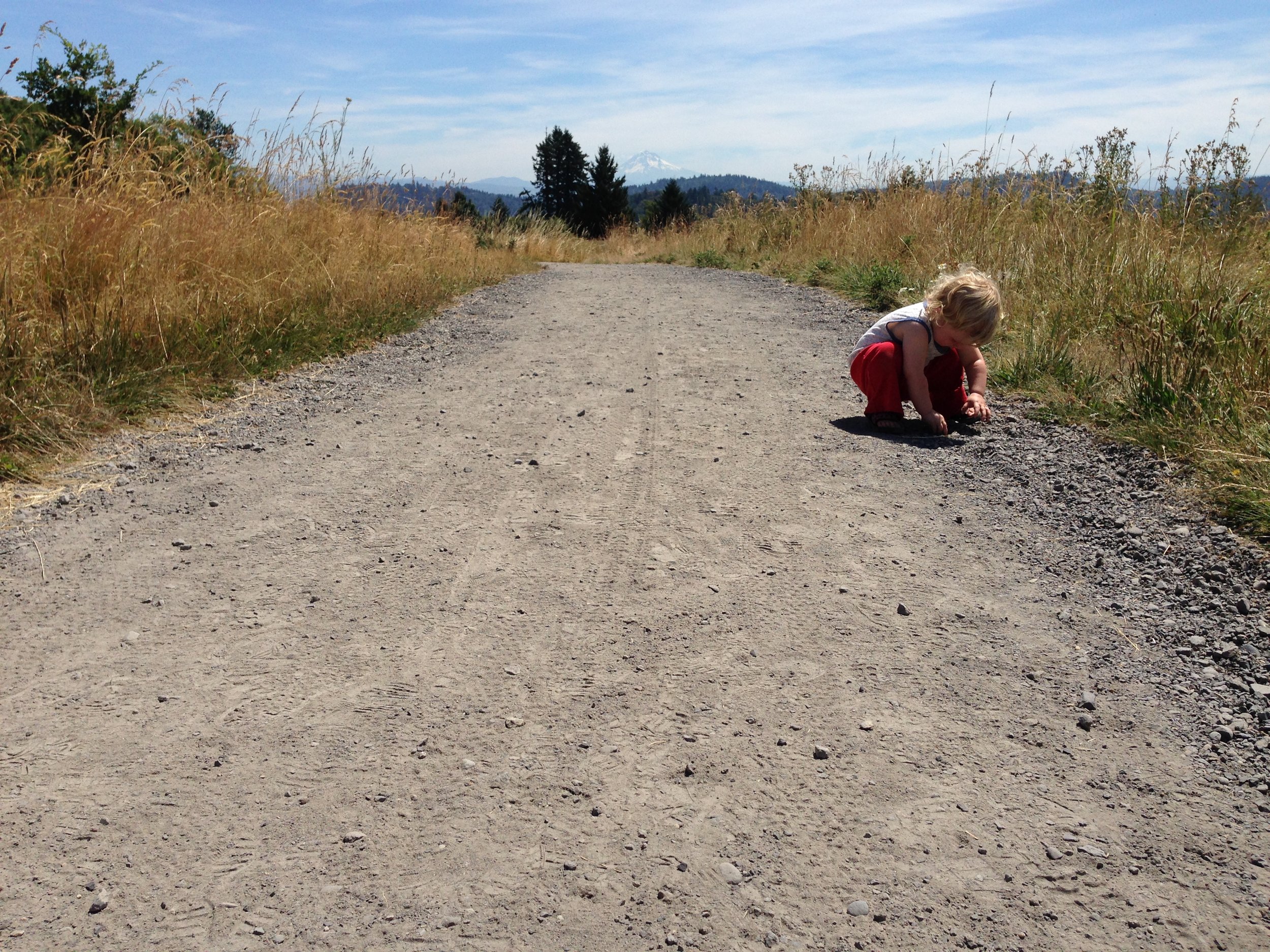
Once, at OMSI (the Oregon Museum of Science and Industry), I observed a parent repeatedly lifting their toddler so the child was able to drop plastic balls into a funnel of swirling water. The child mechanically complied but expressed no real excitement or pride at the feat. Imagine instead if the parent had stepped back to observe and, noticing the child’s struggle, simply acknowledged the child’s frustration at not being quite tall enough to reach the lip of the funnel. Likely the child would have either kept trying, flexing their ability to creatively problem solve, or moved on to something more interesting or manageable. Either way it was a missed opportunity for this child, one that also supported an unfortunate dependence on the parent, making the parent integral to the child’s ability to explore their environment. When we trust children to be the initiators and protagonists of their own play we are able to learn more about what interests them and what developmental tasks they’re currently working on.

This also includes allowing some degree of interpersonal struggle. Adults stepping in to solve children’s problems at the slightest sign of conflict implicitly tells them that they need us to solve their problems and undermines their growing abilities to participate in the complex dance of interpersonal interactions. If you do sense a struggle arising, especially if you think it might become physical, you can get down to the children’s level and check in with them, explaining what you see and being ready to calmly block a hit or push if necessary.

… Stay tuned for parts two and three!


Nurturing Spaces: A New Vision for Children’s Home Environments

There was a child went forth every day,
And the first object he looked upon, that object he became,
And that object became part of him for the day or a certain part of the day,
Or for many years or stretching cycles of years.
— Walt Whitman
IMG_7721.JPG

I never imagined that a degree in social work, countless hours (nearly two decades) spent providing childcare in families’ homes, a few years in an early childhood classroom and a passion for beautiful spaces and quality design would have led me here.

I've had the unique experience of spending many hours in other people’s homes, becoming well-versed in the joys, challenges and idiosyncrasies of the home environment.  

Our immediate surroundings can support the unfolding of Our daily experiences or, alternately, create distress and frustration.

Nowhere does this play out more prominently than in a home with young children. Environments ill-suited to the curious and exploratory minds of newly mobile infants and toddlers become a minefield of “NO!” leaving the child to increasingly push limits instead of focusing on other developmental tasks of their age. Spaces overflowing with toys invite distraction, (paradoxically) boredom and, in turn, an unfortunate disregard for the care and keeping of valuable materials. Because, of course, no object can maintain its importance in an endless sea of others.

CA355C66-.jpg

It was an accumulation of similar experiences that brought about the idea for this business—watching many different families struggle with the same exact things and indeed, struggling with them myself as I spent time with children in their homes. All too often I’ve observed children spending their days in environments unsuited to their chronological and/or developmental age. I’ve seen spaces catered to adults with inaccessible materials—beautiful yet frustratingly non-functional from a child’s perspective. I’ve witnessed the way parents inadvertently make more work for themselves when children need assistance to access even the most basic things, like a piece of paper or a cup for water. How can we encourage and expect independence from children when their environments do little to support their growing desire for autonomy?

A few minor modifications to the environment can make a world of difference.

Even the youngest children can participate in the process of caring for their spaces, leading to mastery and self-confidence.   

The most important thing to remember about young children’s environments is that it is largely up to us as caregivers and parents to maintain pleasant and engaging spaces.

No child will ever tell you (with their words) that they have too many toys.

Of course, they will show you (with their behaviors) that they are overwhelmed and unable to focus.

Therefore it is our responsibility to observe the children in our lives, noticing their cues, and modify their environments accordingly.

Imagine an environment where children (even the littlest of littles) play independently and with focused attention for considerable stretches of time. An environment where children are surrounded by beautiful, quality materials that support their optimal development. In this space, children's treasured creations and collections are lovingly and prominently displayed, showing them, “Your work is valued. You are valued.” This “yes” space has been tailored to the interests and developmental stage of each child that uses it and we can feel safe and confident allowing our children to explore freely within it. Let’s imagine homes where parents and caregivers spend no more than ten minutes per day tidying their children’s play space.

Doesn’t that sound nice?

I am so excited to begin this journey supporting families to envision and develop enriching environments where children can learn, explore, imagine, experiment, practice, persevere and create. Your children deserve a nurtured space.

DSC_0003.JPG